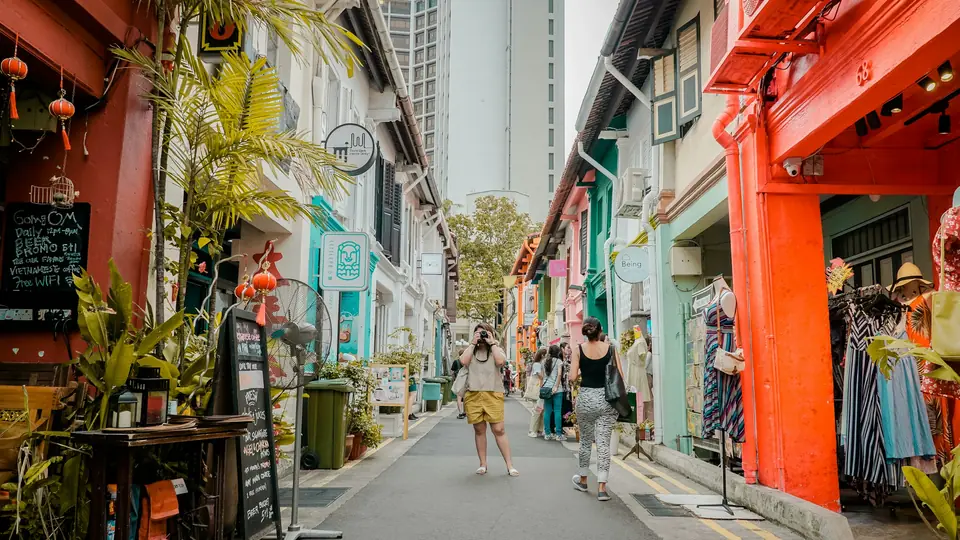







Singapore is the low-tax country banks actually like. It is also a city that doesn’t hand out residence to anyone with a laptop and a dream. You move here because a Singapore company employs you, because investors back your startup, or because you already earn at the top of your field.
This guide covers the practical side of the first 90 days: the pass, the arrival paperwork, the flat, the bank and the tax office. It’s general information as of September 2026, not advice. For corporate tax, dividends and the company itself, see our Singapore country guide.
Which pass fits you#
| Route | Who it’s for | Key requirement (as of 2026) |
|---|---|---|
| Employment Pass (EP) | Professionals, including founders employed by their own Singapore company | Fixed salary from S$5,600 a month (S$6,200 in financial services), rising with age to S$10,700 (S$11,800); 40 COMPASS points unless you earn at least S$22,500 a month |
| EntrePass | Founders of a venture-backed or innovative startup | Private limited company registered with ACRA, at least 30% of the shares; plus one of: S$100,000+ funding round from an eligible investor, recognized incubator or accelerator, registered IP, research collaboration or a previous tech exit |
| ONE Pass | Top earners and people with outstanding achievements | Fixed salary of at least S$30,000 a month; valid 5 years; lets you start and run companies |
| Dependant’s Pass | Spouse and children under 21 of EP or S Pass holders | The main pass holder earns a fixed salary of at least S$6,000 a month |
| Company only | Founders who stay abroad | Registers in a day, but needs a locally resident director and gives you no right to live in Singapore |
EU citizens can visit visa-free, but for living and working there is no special treatment: the same passes apply to everyone.
The honest summary: a one-person consultancy rarely clears COMPASS, because the points reward salary benchmarks, qualifications and a diverse local workforce. The EntrePass is built for startups with investors or IP. Check both with the Ministry of Manpower’s self-assessment tool before you incorporate.
Your first 90 days#
From in-principle approval to Singpass
Before you go: company and pass application
If your own company will employ you, register the private limited company with ACRA through a registered filing agent first. Then the company applies for your pass through the Ministry of Manpower’s EP eService (application fee S$105 as of 2026). Have your degree certificates ready; MOM may ask for proof that they’re verified.
Before you go: in-principle approval
Approval comes as an in-principle approval (IPA) letter. It works as a single-entry visa and gives you six months to enter Singapore and have the pass issued. It also tells you whether you need a medical examination after arrival.
Week 1: pass issuance
Once you’re in Singapore, the employer requests issuance (S$225 per pass). The notification letter arrives by email and lets you start work and travel while the card is produced.
Week 1 to 2: fingerprints, photo and Singpass
Register your fingerprints and photo at the Employment Pass Services Centre within two weeks of issuance, and do any required medical examination. You also set up Singpass, the government login you’ll use for tax, housing and banking. The card follows within about five working days.
Week 1: short-let, phone and transport
Book a serviced apartment for the first month so you can view flats in person. Singtel, StarHub, M1 and several budget operators sell SIM plans; a contactless card works on the MRT and buses from day one.
Month 1: the long-term flat
Most expats rent a condominium unit through an agent; whole public housing (HDB) flats are an option too. Sign, then stamp the lease with IRAS within 14 days (see below).
Month 1: bank account
With your pass and address, DBS, OCBC, UOB and the international banks will open a personal account. Digital banks are faster for day one. Your salary and GIRO direct debits need a local account.
Month 1: family
If your salary qualifies, your company applies for Dependant’s Passes for your spouse and children. International school places are scarce; apply as early as possible.
Month 1: health cover
Foreigners aren’t covered by MediShield Life, the public insurance scheme. Check what your employer’s group policy covers and add private health insurance for yourself and your family.
Month 3: tax basics
You don’t register separately with IRAS as an employee; you’ll be asked to file. Filing for a year of assessment opens on 1 March and closes on 18 April (e-filing). Keep your arrival date on file: 183 days in a calendar year, or the two-year concession for employees, makes you resident.
Month 3: driving licence
You can drive on a valid foreign licence for your first 12 months of residence. After that you need a Singapore licence, which for most foreign licences means passing the Basic Theory Test. Before you buy a car, look at the price of a Certificate of Entitlement and sit down.
Finding a flat#
Rents are our estimate as of September 2026 for unfurnished to furnished condominium units; they’re not official statistics. Singapore’s rental market is quoted in Singapore dollars per month.
| Area | 1-bedroom | 2–3 bedrooms |
|---|---|---|
| Core central (Orchard, River Valley, Tanjong Pagar) | S$4,000–5,500 | S$5,500–9,000 |
| City fringe (Novena, Tiong Bahru, East Coast) | S$3,500–4,500 | S$4,500–7,000 |
| Outside central (Jurong, Tampines, Woodlands) | S$3,000–3,800 | S$3,800–5,500 |
| Whole HDB flat (3–4 rooms, island-wide) | – | S$3,000–4,200 |
- Lease length. The standard is one or two years. Ask for a diplomatic clause: it lets you end the lease early if you lose your pass or are transferred.
- Deposit. Commonly one month’s rent per year of lease, plus the first month in advance. Get the return conditions in writing.
- Stamp duty. Leases are stamped with IRAS at 0.4% of the total rent for leases of up to four years. The tenant pays unless the contract says otherwise, within 14 days of signing in Singapore. Late stamping costs a penalty.
- Agents. Check the agent on the Council for Estate Agencies register. For smaller rentals, tenants often pay a commission; clarify it before you view.
- Aircon servicing. Leases usually oblige the tenant to service the aircon every few months. Budget for it.
What it costs per month#
Estimate as of September 2026, based on our own research and typical asking prices; not official statistics. Single in a 1-bedroom condo, couple in a 2-bedroom, both outside the core centre. No car, no school fees.
| Item | Single | Couple |
|---|---|---|
| Rent (condo, city fringe or outside central) | S$3,200–4,800 | S$4,500–7,000 |
| Utilities (electricity with aircon, water) | S$120–250 | S$180–350 |
| Mobile and internet | S$50–90 | S$80–130 |
| Groceries | S$400–700 | S$700–1,100 |
| Health insurance (private top-up) | S$100–300 | S$200–600 |
| Transport (MRT, bus, ride-hailing) | S$120–300 | S$200–450 |
| Eating out and other | S$500–1,000 | S$800–1,500 |
| Total | S$4,490–7,440 | S$6,660–11,130 |
At roughly S$1.50 to the euro, that’s about €3,000–5,000 for a single and €4,400–7,400 for a couple. Hawker centres keep the food line honest; the condo pool doesn’t.
Documents to bring#
What goes in the folder
Tick them off – your progress is saved in this browser only.
Valid for well beyond your planned pass period, plus copies.
Needed for COMPASS and the EP. Have verification ready; MOM can ask for it.
Your contract with the Singapore employer, or ACRA registration, shareholding and business plan for the EntrePass.
Term sheets and investor details, incubator or accelerator confirmation, IP registrations or research agreements, whichever criterion you use.
For Dependant’s Passes. Translations into English if they’re in another language.
Private cover for you and your family, since public schemes don’t apply to foreigners.
Banks ask where your money comes from. Statements, tax returns and sale contracts save time.
Plus an international driving permit or an official English translation if it isn’t in English.
Common traps#
Where Singapore moves go wrong
Treating the company as the visa.
Incorporation takes a day; the pass is the hard part. Check COMPASS or the EntrePass criteria before you spend money.
Letting the IPA expire.
You have six months from in-principle approval to arrive and get the pass issued. Miss it and you start over.
Forgetting the fingerprint appointment.
Registration is due within two weeks of issuance. Book it before you land.
Unstamped leases.
Stamp duty is due within 14 days of signing in Singapore. Late means penalties, and an unstamped lease is weak evidence in a dispute.
Assuming remittances are always tax-free.
Individuals don’t pay tax on foreign-sourced income. Companies do when they bring foreign income into Singapore, unless an exemption applies.
Running the company from Europe.
A resident nominee director doesn’t move the place of management. Your home country will tax the company if you run it from there.
Taxes and days#
As an individual resident, you pay 0–24% on Singapore employment and business income. Dividends from Singapore companies and foreign-sourced income are not taxed, even if you bring the money in. There’s no capital gains tax, and foreigners don’t pay into CPF, the local pension system. You’re resident with 183 days in a calendar year; employees can also qualify through a two-year concession if their stay straddles two years.
The other side of the move is your old country. A work pass doesn’t end tax residency in Germany by itself; see our tax residency guide and the leaving Germany checklist, and log your days with the day tracker.
This guide is general information, not tax or legal advice. Want company, pass and exit planned in the right order? Book a strategy session, or compare Singapore with Dubai and others in the Jurisdiction Finder.
FAQ#
Can I get residence by setting up a Singapore company?
Not automatically. You still need a work pass, and your company must meet its criteria: the EP salary and COMPASS points, or the EntrePass funding or innovation tests.
How long does the Employment Pass take?
Most applications are decided within a few weeks. After approval you have six months to arrive and get the pass issued, which happens on the spot once you’re in Singapore.
Can my partner work in Singapore?
A Dependant’s Pass lets your spouse live in Singapore. To work, they generally need their own work pass through an employer.
Do I pay tax on dividends from my company?
Not in Singapore: dividends are tax-free for shareholders under the one-tier system. If you’re still tax resident in Germany, Germany taxes them.
Do I need a Singapore driving licence?
Only after 12 months. Until then your valid foreign licence works; afterwards you convert it, usually by passing the Basic Theory Test.
Is foreign income taxed if I bring it to Singapore?
Not for individuals, except in narrow cases such as income received through a Singapore partnership. Companies are taxed on foreign income received in Singapore unless an exemption applies.
Sources#
- Ministry of Manpower – Employment Pass eligibility and COMPASS
- Ministry of Manpower – apply for an Employment Pass (IPA, fees, issuance)
- Ministry of Manpower – EntrePass eligibility
- Ministry of Manpower – ONE Pass eligibility
- Ministry of Manpower – Dependant’s Pass eligibility
- ACRA – setting up a local company
- IRAS – working out your tax residency
- IRAS – individuals required to file tax
- IRAS – stamp duty when renting a property
- Singapore Police Force – Singapore driving licence
- PwC Worldwide Tax Summaries – Singapore, individual